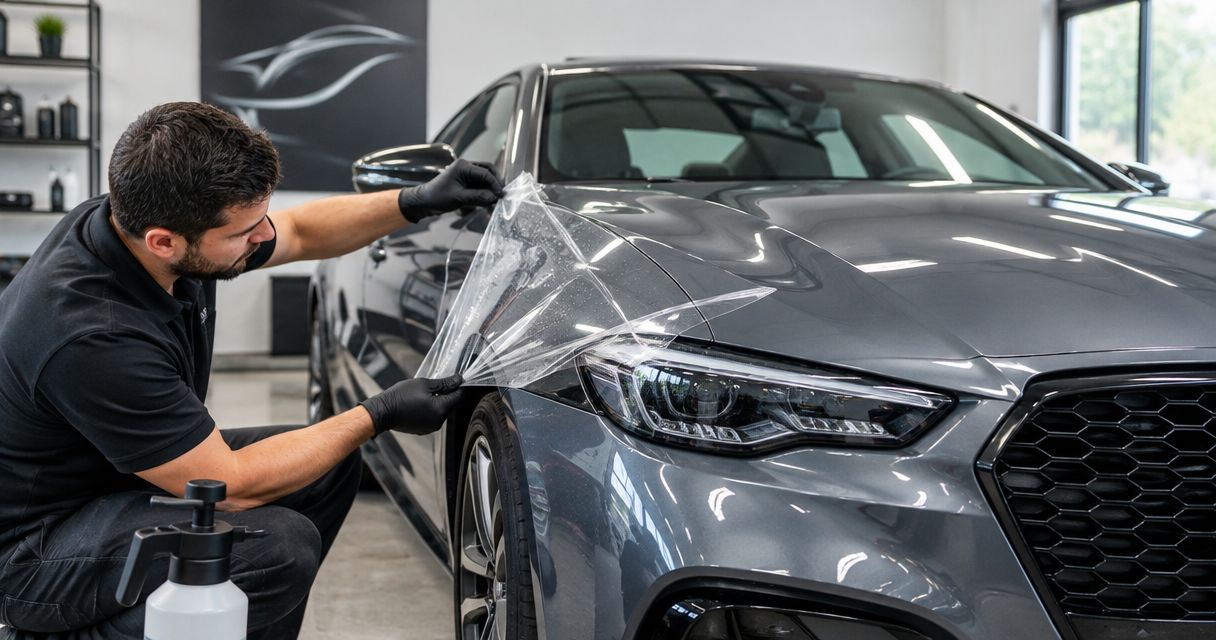
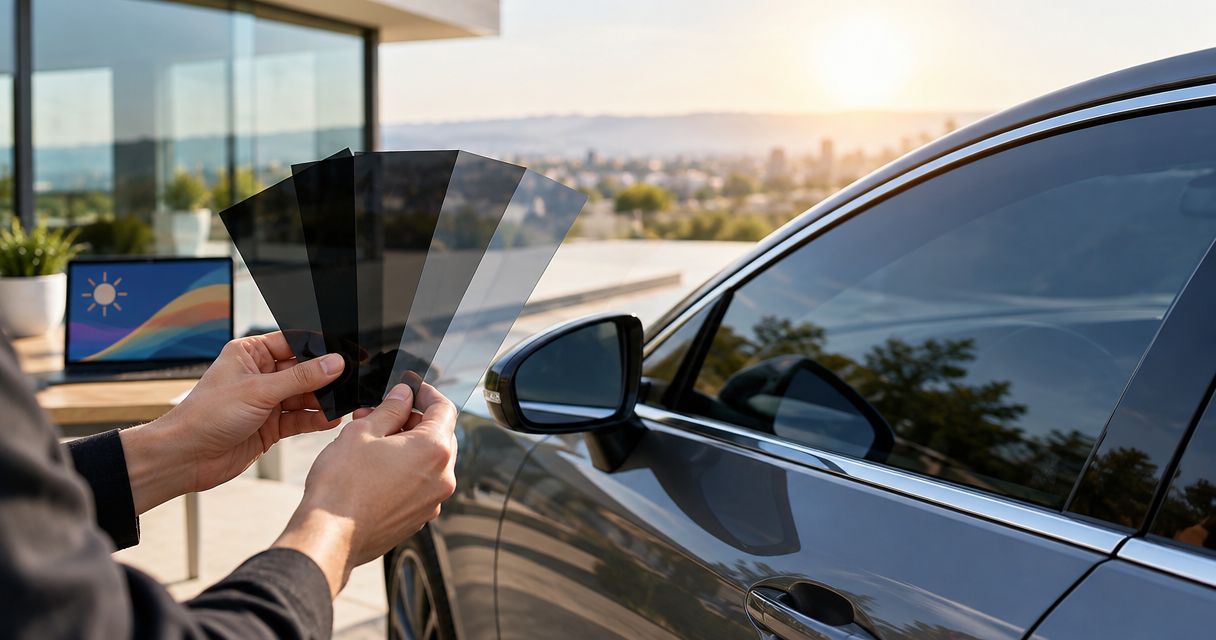
Best overall for heat rejection: a ceramic window tint film with a high published total solar energy rejected (TSER) rating at your chosen darkness. Best for a lighter appearance: a spectrally selective film with strong TSER at a higher visible light transmission (VLT). Best for appearance rather than cooling: dyed film. This 2026 ranking compares film types, not unverified brand-name products; the published specification for the exact film and glass combination decides which film rejects more heat.
- For the best window tint film heat rejection in 2026, compare TSER at the same VLT; start with ceramic film.
- Spectrally selective film is the better starting point when you want heat control with a lighter appearance.
- Metallized, carbon and dyed films need product-specific TSER figures before you rank their cooling performance.
- Supreme Auto Spa NJ offers window tinting for North Jersey vehicle owners; confirm the film and window specifications before installation.
For North Jersey vehicle owners considering tint, Supreme Auto Spa NJ offers window tinting. Ask which film would go on each window and request its TSER and VLT specifications. A film that looks darker is not automatically the film that rejects the most solar heat.
Why heat rejection matters
Sunlight heats the glass, seats and surfaces inside your vehicle. Window tint can reduce the solar energy entering through glass, but film types and individual products perform differently. In 2026, a useful tint comparison starts with TSER at a specified VLT, not a headline infrared-rejection claim viewed in isolation.
VLT describes how much visible light passes through the filmed glass. A 35% VLT figure means 35% of visible light passes through under the stated test conditions; it does not mean the film rejects 65% of solar heat. TSER addresses a different question: how much total solar energy the glazing rejects. Keep those measures separate when you read a specification sheet.
Window position matters too. You cannot pick a film for the windshield, front side windows and rear windows solely by its heat rating. Check the current rules that apply to each window before choosing a darkness for a vehicle driven in New Jersey.
What makes the best window tint film for heat rejection?
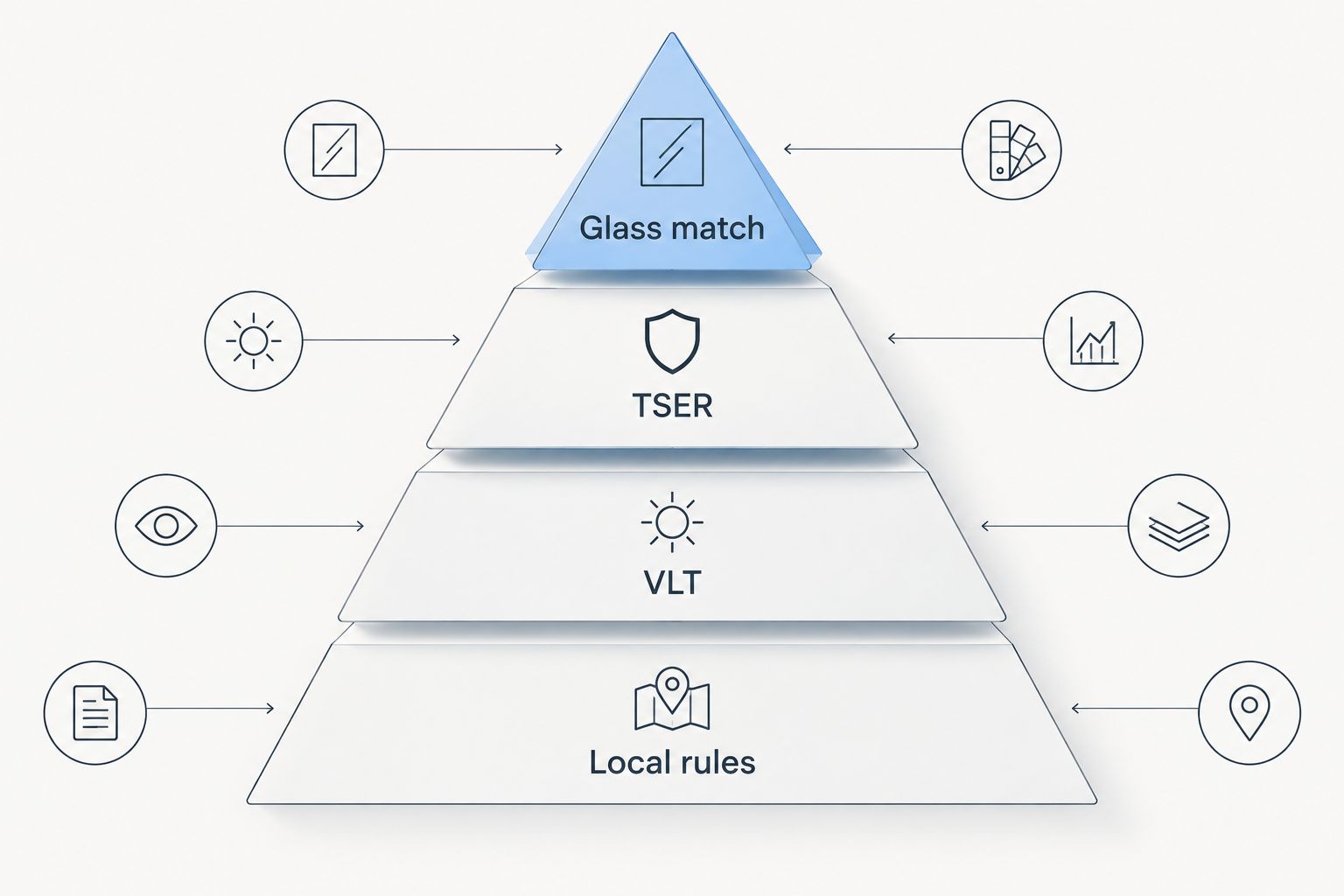
Use these criteria in order. They let you compare actual film specifications rather than treating a material name as a performance guarantee.
- TSER: Compare total solar energy rejected for the exact film you are considering. Higher TSER is the relevant result when the goal is less incoming solar heat.
- VLT: Compare films at the same visible-light level. A much darker film can make a heat-rejection comparison misleading if you actually want a lighter window.
- Glass match: Ask whether the listed figure applies to the film alone or to film installed on a specified type of glass. Those are not interchangeable claims.
- Local rules: Choose a film and window placement that meet the rules where you drive. A strong heat rating does not make an otherwise restricted application suitable.
- Signal compatibility: Consider a nonmetallic film if avoiding metal-related reception concerns is part of your decision.
The best heat-rejecting window tint is the compliant film with the highest relevant TSER at the VLT you want. That rule is more useful than declaring every ceramic film better than every metallized film. Construction and published performance differ across products.
A 2026 specification sheet that advertises infrared rejection at 900 nm gives you information about that wavelength, not a complete account of solar heat. Infrared spans a much wider range. Request TSER alongside any infrared figure, and check what the infrared test actually measures.
Window tint film types at a glance
This is a shopping order by use case, not a claim that every film in one row outperforms every film below it. Without named products and comparable TSER results, no film-type ranking can establish a universal heat-rejection winner.
| Film type | Best for | Standout feature | Key limitation |
|---|---|---|---|
| High-TSER ceramic | Heat rejection at your chosen VLT | Nonmetallic construction with product-specific solar-control options | Ceramic alone does not establish a TSER result |
| Spectrally selective | Heat control with a lighter appearance | Targets parts of the solar spectrum while allowing visible light through | A lighter look does not prove a higher TSER |
| Metallized | Considering reflective solar control | Metal layers can reflect incoming energy | Metal content introduces signal-compatibility concerns |
| Carbon | A nonmetallic alternative | Carbon-based construction without a metal layer | Heat performance needs its own TSER figure |
| Dyed | Appearance-first tint | Adds color without relying on a metal layer | Darkness is a poor substitute for measured heat rejection |
The first two rows can overlap: a film can be both ceramic and spectrally selective. The distinction here is what you are choosing it for. The first pick prioritizes the strongest documented TSER at a workable VLT; the second prioritizes a lighter appearance while retaining documented heat control.
1. High-TSER ceramic: best window tint film for heat rejection
Ceramic films use nonmetallic particles as part of their solar-control construction. For the buyer focused on cabin heat, the right pick is not simply a box marked ceramic. It is the ceramic film with the strongest relevant published TSER that also meets your desired VLT and the rules for that window.
Ceramic film does not create a metal layer that prompts the same signal-compatibility question as metallized film. That makes it a practical first category to investigate in 2026, especially when you want to compare several darkness levels without treating darkness itself as the performance measure.
Ceramic film pros:
- Provides a nonmetallic route to solar control.
- Gives you a clear basis for comparison when the manufacturer publishes TSER and VLT.
- Lets you choose by window and light level rather than assuming the darkest option wins.
Ceramic film cons:
- The word ceramic does not specify how much heat an individual film rejects.
- A film's published result still needs the right glass and VLT context.
Best for: Drivers whose first priority is documented heat rejection at a usable, permitted darkness. Verdict: Buy only after checking the exact film's TSER and VLT.
2. Spectrally selective film: best for a lighter appearance
Spectrally selective films are designed to control parts of incoming solar energy without depending entirely on a dark visible appearance. Some use ceramic technology, so this category is not an alternative material in every case. Treat it as a separate shopping question: how much heat can you reject while preserving the amount of visible light you want?
This matters when a driver wants a lighter-looking window or when the rules for a particular window narrow the VLT options. In either situation, compare published TSER figures at the VLT you can actually use. Do not assume that an infrared figure alone predicts the overall result.
Spectrally selective film pros:
- Centers the comparison on heat control at a higher VLT.
- Gives drivers a way to compare lighter-looking options.
- Can be evaluated through the same TSER and VLT criteria as darker films.
Spectrally selective film cons:
- The label does not guarantee a particular TSER.
- Film-specific construction determines whether metal-related signal concerns apply.
Best for: Drivers who want documented heat control without choosing darkness as the main tool. Verdict: Buy when the film's full specifications support that balance.
3. Metallized film: best for reflective solar control
Metallized films incorporate metal layers that can reflect some incoming solar energy. They deserve a place in a heat-rejection comparison, but the presence of metal is not a TSER measurement. Put a specific metallized film beside a specific ceramic film at a comparable VLT before deciding which performs better.
The trade-off is signal compatibility. Metal in window film can interfere with some radio-frequency signals, so establish what matters in your vehicle before selecting it. If avoiding that concern is a firm requirement, a nonmetallic option gives you a simpler starting point.
Metallized film pros:
- Uses reflective construction for solar control.
- Can be compared directly with other films when TSER and VLT are published.
- Offers a distinct construction choice for drivers considering reflective tint.
Metallized film cons:
- Metal content raises a signal-compatibility question.
- Reflection alone does not establish the film's total heat rejection.
Best for: Drivers considering reflective film who can confirm both measured heat performance and signal compatibility. Verdict: Hold until both are clear.
4. Carbon film: best nonmetallic alternative to compare
Carbon film uses carbon-based material rather than a metal layer. That makes it another category to compare when you want nonmetallic tint, but carbon does not describe one fixed level of heat rejection. Two carbon films can have different published performance.
In a 2026 shortlist, carbon earns its place through its specific TSER at the VLT you intend to use. Compare that figure with ceramic options on the same basis. If the numbers are not available, the construction name cannot tell you which will keep more solar energy out of the cabin.
Carbon film pros:
- Avoids a metal layer in the film's construction.
- Gives you another nonmetallic option to assess against ceramic.
- Can be judged with the same TSER and VLT measures as other films.
Carbon film cons:
- Carbon is not a guarantee of strong heat rejection.
- A dark appearance can distract from a missing TSER figure.
Best for: Drivers comparing nonmetallic tint options with published specifications. Verdict: Hold until you can compare its TSER with ceramic film at a similar VLT.
5. Dyed film: best for appearance-first tint
Dyed film adds color to the glass through dye in the film construction. It can change how the windows look, but a darker appearance does not establish strong total solar heat rejection. That makes it the wrong default when your main complaint is a cabin that heats up in the sun.
A dyed film still belongs in the comparison because not every driver has the same goal. If appearance comes first, assess the film on its published specifications and your preferred VLT. If heat comes first, start with documented TSER results from the other categories instead of using visible darkness as a shortcut.
Dyed film pros:
- Provides an appearance-focused tint option.
- Does not rely on a metal layer.
- Can be assessed against other films when TSER and VLT are available.
Dyed film cons:
- Visible darkness does not establish effective heat rejection.
- It is a weak default for a heat-first purchase without a competitive TSER figure.
Best for: Drivers choosing tint primarily for appearance rather than maximum measured heat control. Verdict: Skip for a heat-first shortlist unless its specific TSER supports it.
How this 2026 ranking works
The order prioritizes a driver's decision, not an invented laboratory result. High-TSER ceramic comes first as the clearest heat-first specification search. Spectrally selective film follows for drivers who want a lighter appearance. Metallized and carbon require direct product-level comparison, while dyed film is an appearance-first choice.
No named film, installation method or brand receives a performance claim here. To turn this category guide into a purchase decision, compare the actual film offered, its TSER, its VLT, and the glass conditions behind the rating. If two spec sheets use different test conditions, ask for comparable figures before treating either as the winner.
Which window tint film should you choose?
Choose a ceramic film with the highest documented TSER that fits your permitted VLT if heat rejection is the priority. Choose a spectrally selective option when a lighter appearance is equally important, then check its TSER against other films at that light level. Do not pick dyed film just because it looks dark or reject metallized and carbon films without reading their product-specific figures.
For a vehicle in North Jersey, Supreme Auto Spa NJ provides window tinting, but this article does not identify the films available for a particular installation. Ask Supreme Auto Spa NJ for the exact film specifications and confirm which windows you plan to tint before making the decision. That keeps the 2026 recommendation tied to your vehicle rather than a category label.
Discuss your window tint options
Ask about film specifications and the windows you want tinted.
FAQ
What is the best window tint film for heat rejection?
A film with high published TSER at your chosen, permitted VLT is the best heat-first choice. Start by comparing ceramic options, then check the exact film's specifications rather than relying on its material name.
Does darker window tint reject more heat?
Darker tint is not automatically better at rejecting total solar heat. Compare TSER at a VLT you can use; VLT describes visible light, not total heat rejection.
Is ceramic window tint better than carbon for heat?
The specific ceramic film with the higher comparable TSER rejects more total solar energy. Ceramic and carbon are construction categories, not fixed performance ratings.
Is ceramic tint better than metallized tint?
Neither construction wins without comparable film-specific TSER figures. Ceramic is nonmetallic, while metallized film also requires a signal-compatibility check.
What does TSER mean on a window tint specification?
TSER means total solar energy rejected. Read it alongside VLT and the stated glass conditions so you compare films on the same basis.
Is an infrared-rejection rating enough to choose window tint?
No, an infrared-rejection rating alone does not establish total solar heat rejection. Check which wavelengths the rating covers and request TSER for the film you are considering.
Can I choose the same tint for every car window in New Jersey?
Check the current New Jersey rules for each window before choosing film. The permitted application can differ by window position, so select a compliant VLT for each planned installation.
One last thing
The most useful question to ask about a 2026 tint recommendation is not whether the film is ceramic. Ask: What is this exact film's TSER at the VLT appropriate for my window, and what glass was used to produce that figure? If the answer is only a darkness label or a single-wavelength infrared claim, you still do not have a sound heat-rejection comparison.